

Mike | The Lab
Published on
How to backtest trading strategies
Backtesting transforms speculation into evidence-based trading. With proper historical testing, you identify which strategies have statistical edge before risking real capital. Without backtesting, you're trading blind, relying on hope instead of data.
Most traders skip backtesting entirely or do it incorrectly, leading to false confidence in strategies that fail live. The successful ones? They test consistently, avoid common pitfalls, and only trade strategies proven through hundreds of historical simulations.
Here's everything you need to know about backtesting trading strategies, from data preparation to result analysis, backed by the frameworks professional traders use to validate edge before deployment.
What is backtesting and why it matters
Backtesting is the process of testing a trading strategy against historical market data to evaluate its potential performance. You apply your strategy's entry and exit rules to past price data, simulating trades as if you had executed them in real-time.
The goal is to answer one critical question: Would this strategy have made money in the past? If a strategy can't perform well on historical data, it's unlikely to succeed going forward.
Backtesting provides objective metrics about strategy performance, win rate, average gain versus average loss, maximum drawdown, profit factor, and other statistics that reveal whether your approach has genuine edge or is simply random guessing.
But why it matters?
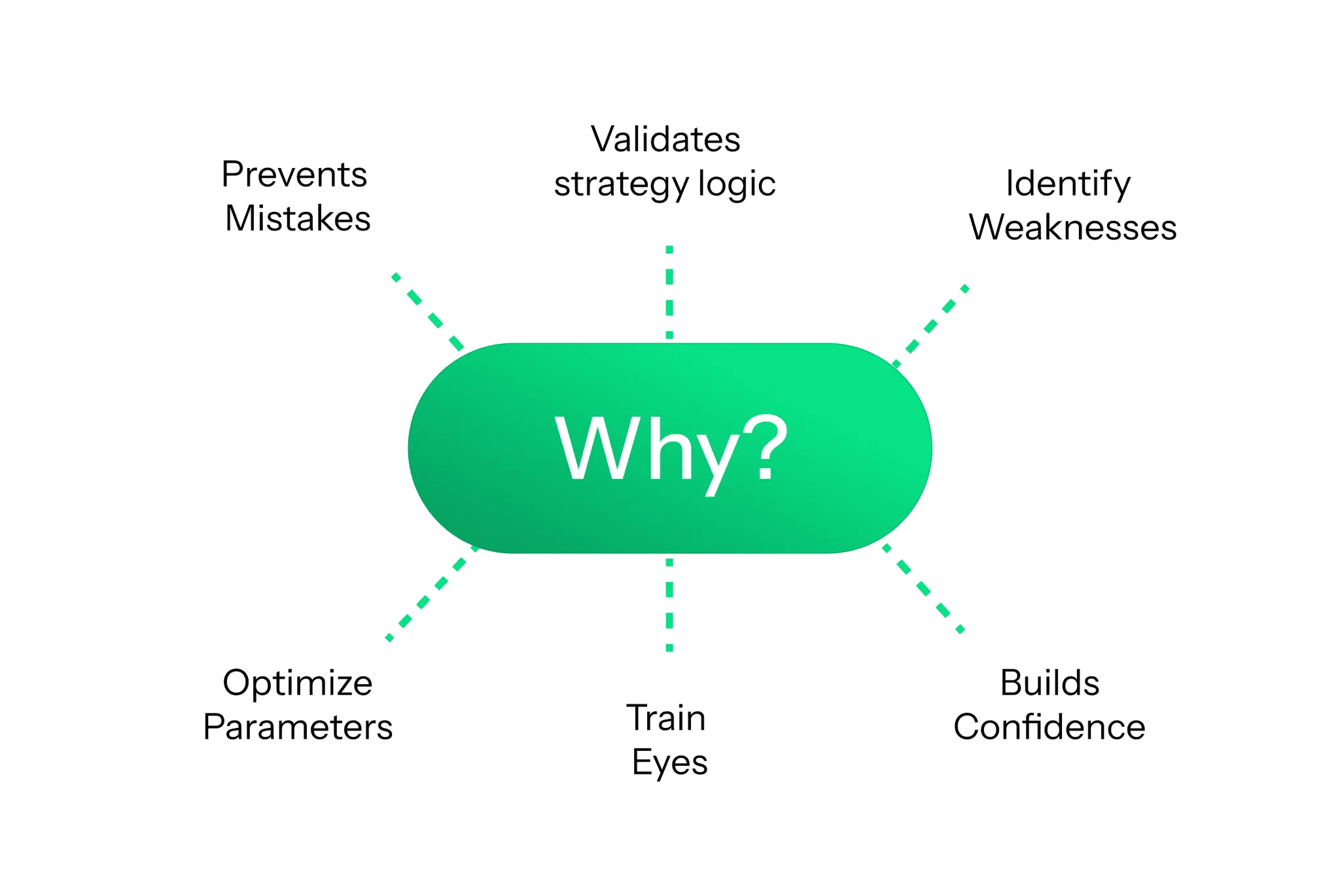
Validates Strategy Logic: Tests whether your trading thesis holds up under real market conditions across extended periods
Identifies Weaknesses: Reveals flaws in strategy design, parameter choices, or market assumptions before live trading exposes them
Builds Confidence: Seeing positive results across hundreds of historical trades creates psychological foundation to execute the strategy during inevitable losing streaks
Optimizes Parameters: Allows systematic testing of different settings to find optimal balance between performance and robustness
Prevents Costly Mistakes: Catches strategy flaws in simulation rather than discovering them with real capital at risk
Without backtesting, you're essentially guessing. With thorough backtesting, you're operating from evidence.
Backtesting vs Forward Testing
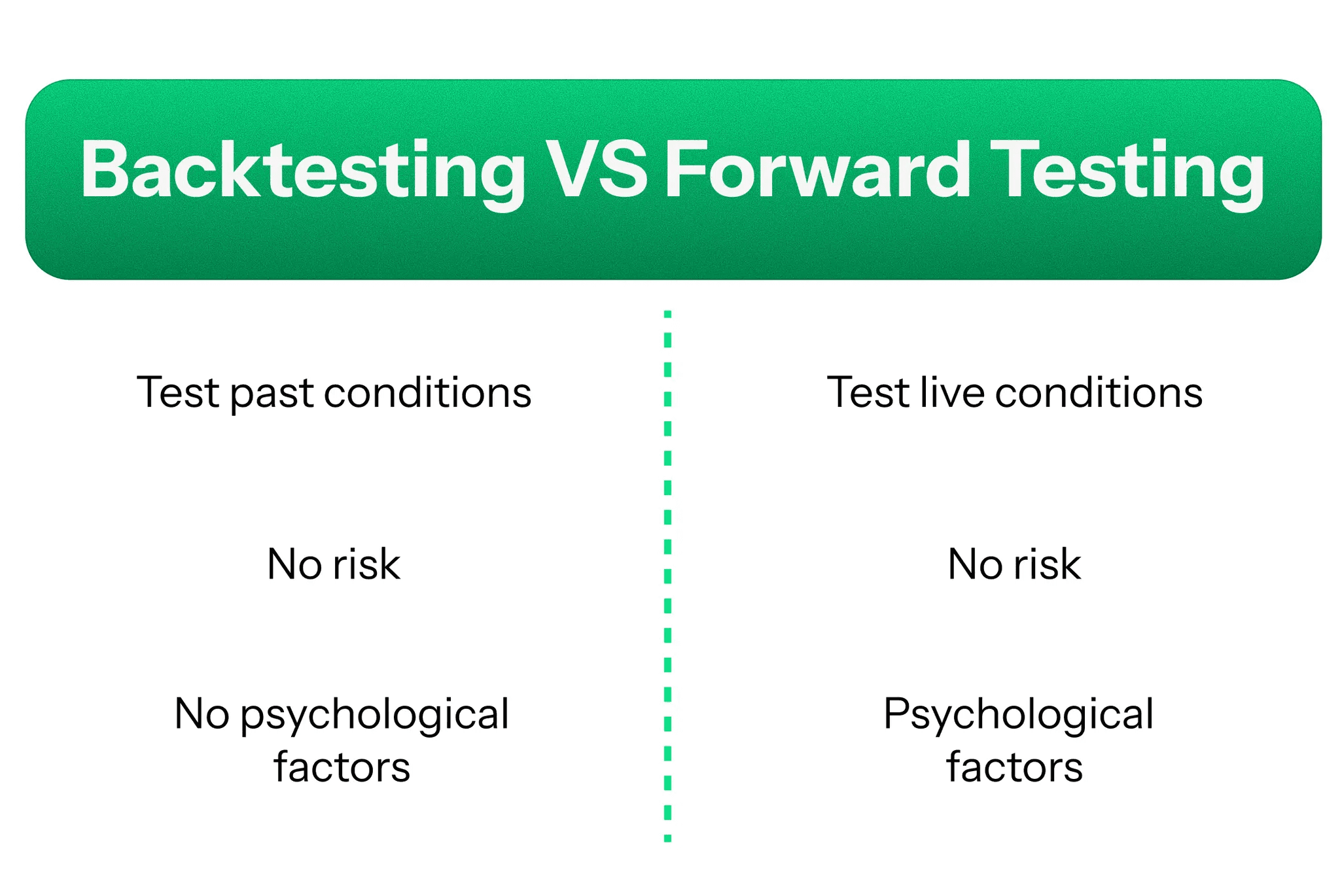
Both backtesting and forward testing validate strategies, but they serve different purposes and occur at different stages.
Backtesting (Historical Testing)
What It Is: Testing strategy against past data to see how it would have performed
When To Use: Initial strategy validation before risking any capital, even paper trading capital
Advantages: Fast results (test years of data in hours), complete control over conditions, ability to iterate quickly
Limitations: Historical performance doesn't guarantee future results, can't capture execution challenges, easier to introduce bias
Forward Testing (Paper Trading)
What It Is: Testing strategy in real-time market conditions with simulated capital
When To Use: After successful backtesting, before live trading with real money
Advantages: Tests strategy in current market conditions, captures execution challenges, includes psychological factors
Limitations: Time-consuming (must wait for real-time price action), doesn't test strategy across different market environments
Optimal Workflow: Backtest → Forward test → Live trading with small size → Scale up
Skipping either step increases failure probability. Backtesting without forward testing misses real-time execution issues. Forward testing without backtesting wastes time on strategies with no historical edge.
Preparing Your Backtesting Session
Before testing strategies, establish the framework for your analysis.
Select Your Symbols
Identify specific assets for testing. Don't just test "stocks" generically. Test specific symbols with historical data available.
Futures Examples: ES (S&P 500 E-mini), NQ (Nasdaq E-mini), CL (Crude Oil), GC (Gold)
Forex Examples: EURUSD, GBPUSD, USDJPY, AUDUSD
Stock Examples: SPY (S&P 500 ETF), AAPL, TSLA, or stocks meeting specific criteria (market cap, sector, liquidity)
Choose symbols that match your intended trading universe. Testing a strategy on highly liquid futures that you plan to trade on illiquid small-cap stocks produces irrelevant results.
Acquire Quality Historical Data
Data quality determines result validity. Garbage data produces garbage insights.
More data provides better statistical significance but ensure market conditions within the data range remain relevant. Testing a strategy on 1980s stock data may not reflect current market microstructure.
Choose Your Timeframe
Timeframe selection depends on your trading style and strategy type.
Intraday Timeframes: 1 minute, 5 minute, 15 minute charts for day trading and scalping strategies
Swing Trading Timeframes: 1 hour, 4 hour, daily charts for positions held multiple days
Position Trading Timeframes: Daily, weekly charts for longer-term trend following
Multiple Timeframe Analysis: Use higher timeframe for trend direction, lower timeframe for entry refinement. Test on the timeframe you'll actually use for execution.
Define Trading Hours
Different sessions exhibit different characteristics. Your backtest must match your intended trading hours.
Testing a strategy across 24 hours when you only plan to trade the New York open produces misleading results. Match backtest conditions to intended execution environment.
Building Your Strategy Playbook
Document every aspect of your strategy before backtesting begins. Vague rules produce unrepeatable results.
Define Entry Criteria
Entry rules must be objective and specific. "Buy when price looks strong" isn't testable. "Buy when price closes above a 5 minute FVG" is testable.
Entry Components: Market condition filter (trending, ranging, volatile), technical setup trigger, confirmation signals, time of day restrictions if applicable
Example Entry Rules:
Only trade between 9:30 AM and 11:30 AM ET
Price must be below midnight for longs and above midnight for shorts
Wait for 5 minute order block to form
Enter long on the bullish order block or short on the bearish order block
The more specific your entry criteria, the more accurately you can test it.
Define Exit Criteria
Exits determine profitability more than entries. Test multiple exit approaches.
Profit Targets: Fixed pip/point/dollar amount, percentage gain, technical levels, trailing stops
Stop Losses: Fixed pip/point/dollar amount, percentage loss, technical stops, volatility-based (ATR multiples)
Time-Based Exits: End of session regardless of P&L, maximum bars in trade, overnight hold or flat
Example Exit Rules: Stop loss: 10 points below entry, profit target: 2RR, time stop: exit at market close if still open, trailing stop: move to breakeven once 1.5RR is reached
Document exactly when and why you exit trades. "Take profit when it feels right" isn't reproducible.
Determine Position Sizing
Position sizing impacts results dramatically. Fixed contract/share sizing creates different risk profiles than percentage-based sizing.
Make sure to check out our blogs for this, we shared a lot of important informations about position sizing.
Executing the Backtest
With preparation complete, run your historical simulation.
Apply Rules Consistently
Execute your strategy exactly as documented without deviation. The temptation to adjust based on hindsight is strong. Resist it.
Use the same discipline you'd apply in live trading. If your rule says enter at market close, don't give yourself the best price of the next bar. Use realistic execution prices including slippage estimates for market orders.
Track Every Trade, granular data enables deep analysis beyond just total profit/loss.
You should also support all of your backtesting with screenshots, as visual documentation helps refine discretionary elements and identify patterns.
Manual vs Software Backtesting
Two approaches exist for running backtests: manual or automated through software.
Manual Backtesting
Process: Open historical chart, scroll through bar by bar, manually mark entries/exits, record results in spreadsheet
Advantages: Deep familiarity with price action, develops pattern recognition, no coding required, complete control over discretionary decisions
Disadvantages: Extremely time consuming, prone to human error and bias, difficult to test large samples, hard to optimize parameters systematically
Best For: Discretionary strategies with subjective elements, initial strategy validation before coding, traders who learn kinesthetically through doing
Software Backtesting
Process: Define strategy rules in software, run automated simulation across historical data, receive statistical results
Advantages: Fast execution (years of data in minutes), eliminates human bias, large sample sizes easily tested, systematic parameter optimization possible
Disadvantages: Requires learning software or coding, discretionary elements difficult to program, potential for technical errors in code, over-optimization temptation
Best For: Systematic mechanical strategies, large scale testing across multiple symbols and timeframes, strategies with clear objective rules
Key Principles for Reliable Backtesting
Test What You'll Actually Trade: Match backtest conditions to intended execution environment exactly
Maintain Skepticism: Treat strong results with suspicion. Look for why they might be wrong.
Seek Robustness: Strategy should work across different timeframes, symbols, and periods. If it only works on one stock in 2021, it's not a strategy.
Accept Imperfection: No strategy wins 100% or has perfect metrics. Seek positive expectancy, not perfection.
Document Everything: Detailed documentation enables replication and refinement.
Combine with Forward Testing: Never go from backtest directly to full-size live trading.